"Vic: Time works both ways. It's ahead of us too!" (opens in separate window)
the west faces two islams
saturday, september 12th, 2026
 Published in 1996, Samuel Huntington’s "Clash of Civilizations" predicted that, with the end of the Cold War, global conflict would center on the divide between Islamic and Western civilizations. Thirty years later, however, and a quarter-century after 9/11, the principal fault line runs through Islam itself, separating two ideological worlds.
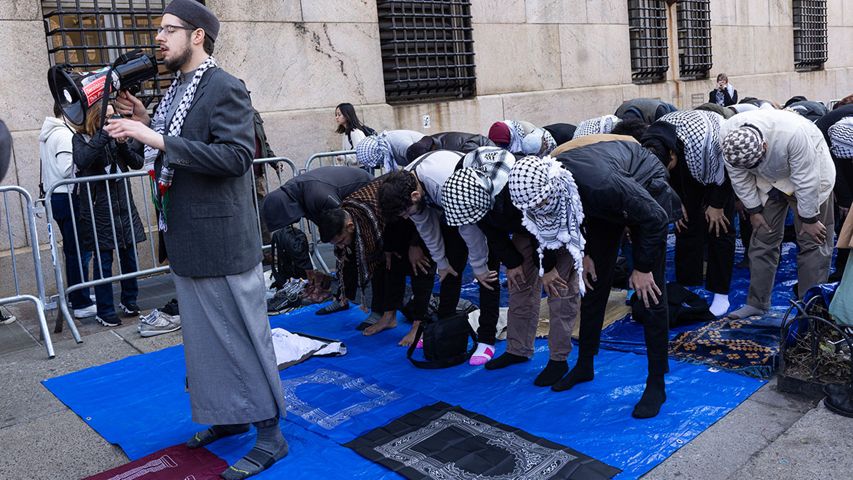
Within Western diaspora communities, Islam has become intertwined with Third-Worldism and postcolonial theory, both of which see Western imperialism as the great evil of the modern era. Meantime, much of the Middle East and Asia has turned toward pragmatism, normalization, and acceptance of Western predominance as a geopolitical reality. The gap between these rival outlooks now exceeds the divide between Islam and the West that Huntington anticipated when his book first appeared. A long-forecast civilizational struggle increasingly plays out not in the Middle East but in Western countries themselves.
After 9/11, American strategy focused on political Islam. Al-Qaeda and its eventual Islamic State offshoot, the Taliban, the Muslim Brotherhood, Hamas, Hezbollah, and Iran’s Islamic Republic differed sharply in theology and tactics but shared a revolutionary ambition to overturn the Western led order. Today, that Islamist challenge has fragmented. Al-Qaeda has splintered, the Islamic State has lost its caliphate, Egypt has outlawed the Muslim Brotherhood, and the Gulf monarchies increasingly treat Islamist movements as threats.
Iran remains the principal revolutionary holdout. The Islamic Republic defines itself through opposition to the United States and Israel while sustaining a regional network of armed proxies. Yet the foundations of that project have weakened. Hezbollah has suffered major battlefield losses, Iranian influence in Syria has contracted, nationwide protests in 2019 and 2022 exposed deep domestic disillusionment, and the ideals of the 1979 Iranian Revolution command little enthusiasm among younger generations. Tehran still exports its revolutionary ideology, but its influence across the broader Middle East continues to wane.
Much of the Middle East has chosen a different course. The Abraham Accords institutionalized security cooperation and trade with Israel. Morocco expanded ties with Jerusalem to strengthen diplomacy, defense, and economic growth. The United Arab Emirates built partnerships spanning artificial intelligence, aviation, finance, and defense. Saudi Arabia evaluates normalization through the lens of security guarantees, advanced technology, its Vision 2030 modernization program, and regional stability. Across the region, partnerships are judged less by ideology than by the capabilities they deliver.
This transformation reflects a broader shift in how Arab and Muslim states understand statecraft. Scientific discovery, industrialization, and institutional innovation have long rewarded societies that adopt the world’s most advanced technologies, regardless of their origin. Middle Eastern governments have embraced the same logic after experiencing the costs of resisting Western innovations—most notably, the Ottoman Empire’s centuries-long restriction on printing in Arabic script until 1727, which left the region lagging in the spread of knowledge long after Europe had surged ahead.
That historical stagnation gave rise to a century of Arab intellectual discourse centered on the crisis of modernity: the painful question of why Islamic societies had fallen behind the West. Thinkers such as Shakib Arslan, in works like Our Decline: Its Causes and Remedies, diagnosed cultural isolation and technological backwardness as the root of the problem and urged selective emulation of Western advances. Leading-edge technologies have become strategic assets because they determine military capability, economic competitiveness, and geopolitical influence. Leaders once legitimized through anti-Western resistance now measure success through modernization.
Western intellectual life has followed a different trajectory. Universities interpret the Middle East through postcolonial theory, with Edward Said’s Orientalism becoming one of the field’s canonical texts. Within that framework, the Israeli–Palestinian conflict serves as the paradigmatic story of settler colonialism and resistance. After October 7, these ideas spread beyond academia into campus protests, divestment campaigns, professional associations, philanthropic organizations, and elections. Palestine became the organizing symbol for broader critiques of American influence, capitalism, and the liberal international order. Muslim identity merged with narratives of dispossession and resistance.
The consequences extend well beyond the campus. Anti-Israel activism once largely confined to Islamist organizations now operates comfortably within progressive politics. Zohran Mamdani’s appointment of Ramzi Kassem—who represented Ahmed al-Darbi after his conviction for the al-Qaeda-linked MV Limburg bombing—as New York City’s chief counsel illustrates that institutional migration. University encampments, municipal resolutions invoking “from the river to the sea,” and coalitions organized around decolonization reflect the same evolution. Revolutionary Islam now finds expression through postcolonial theory rather than religious doctrine. Iranian-aligned clerical networks in places such as Dearborn, Michigan, frame public life around opposition to American influence and solidarity with Tehran.
The same rift has hardened in Europe, where diaspora activism contrasts with the pragmatism of Middle Eastern governments. Universities and progressive institutions have embraced postcolonialism, entrenching narratives of permanent resistance and contributing to a sharp rise in anti-Semitism, particularly on British campuses, where incidents increased more than fourfold after October 7. Gulf states view these environments as incubators of radicalization. The UAE, for example, removed British universities from its state scholarship program—even though nearly 9,000 Emirati students had studied in the U.K. in recent years—while still funding study in Israel.
These trajectories suggest sustained confrontation. The version of Islam that has emerged within Western universities, activist groups, and progressive politics clashes with both the Western societies in which it operates and the Middle Eastern governments now abandoning revolutionary politics.
Three forces drive this collision. First, the opposing sides draw political legitimacy from different sources. Much diaspora activism is rooted in historical grievance, anticolonial struggle, and opposition to Western influence, producing an anti-system worldview in which cooperation with the U.S.-led order can itself signify submission or betrayal. Pragmatic Middle Eastern governments increasingly see cooperation with the United States and Israel as a means to strengthen security, attract investment, acquire technology, and accelerate economic growth. This divide now plays out across Western democracies, where boycotts, campus protests, municipal resolutions, and electoral campaigns target both Arab governments pursuing these partnerships and the Western institutions that support them.
Second, priorities have diverged between governments in the Middle East and North Africa and some of their diasporas in the West. Regional governments increasingly prioritize investment, technology, military strength, and economic growth. Saudi Arabia and the UAE, for example, are investing heavily in AI and data centers. Meantime, several pro-Palestinian movements in the West have expanded their campaigns from opposition to Israeli technology contracts to opposition to the data centers and cloud infrastructure supporting them. The divide increasingly places diaspora activism at odds with the economic and technological priorities of regional governments and complicates relations with the United States.
Third, Western institutions amplify the diaspora vision far beyond its demographic weight. Universities, philanthropic foundations, professional associations, media organizations, and segments of electoral politics have absorbed postcolonial ideas that recast Middle Eastern affairs through the lens of decolonization and racial justice. By contrast, Gulf restrictions on Islamist financing and expanding cooperation with Israel reflect a deliberate effort to contain the same ideological currents sweeping across Western public life. The United States and Europe thus face pressure from two directions: an ideological movement extending its institutional reach at home; and regional allies that regard that same movement as a direct threat.
Huntington was right that culture would matter after the Cold War, but he misidentified the principal fault line. Political evolution within civilizations matters more than the boundaries between them.
The United States will continue to confront Islamism in the twenty-first century. But the principal challenge will not come from Huntington’s civilizational Islam, but instead from the version the West has itself helped cultivate: a diaspora Islam molded by Third-Worldism, postcolonial grievance, and a politics of permanent resistance.
© 0.0.2026 by Zineb Riboua, "City Journal".
A Day In The Life.

Up at 8:00a on Saturday, a warm, 72°F, cloudy sky, humid (69%), a no breeze orning, I upped the AC briefly, made coffee, fired-up the Win-7 Pentium HP Desktop to let its 32 million lines of code load, had breakfast, had a couple smokes in the garage and checked the leftover errands list. Zero. I scanned the weather and the breaking news websites, tuned into a "CP Show" Podcast 9-12 on local WSBA-910, and relaxed for the morning. Sherry would be here around 1p. I had much less pain today than the past 4-5 days, and with the help of aspirin and Tramadol, and 3 exercises, I hoped for a decent day and time with Sherry.
I had a late breakfast, and Sherry arrived around 1p. Because of the past 4-5 days of pain, and I still had minor pain, we stayed inside and spent the time catching-up, from over a week of not seeing each other. She left around 5:30p, to get some gas to get home, and I watched what passes for news, on FNC. After dinner, I switched to Discovery's "Filthy Fortunes" and "Expedition Unknown", until 1a. Lights out.

Never forget or forgive!
Up at 9:30a on Sunday, a beautiful, sunny, low humidity, 63° morning, I made coffee, scanned the news and weather websites, and relaxed. I had R/S pain again, but watched the 2026 Italian Gran Prix highlights, started the first of 2 loads of laundry, and did some condo chores.
Laundry done, I grabbed a 2hr nap on the LR couch, watched the evening news (on NEWSMAX, not FNC) and switched to History's "The Cars That Built America" and Discovery's "Homestead Rescue: Intervention" until 1a, and bagged it for the night.
Up at 7:30a on Monday, a beautiful, sunny, low humidity, cool 53° morning, I made coffee, fired-up the HP Desktop and scanned the news and weather sites, tuned into the "CP Show" with a sub-host, and relaxed, while paying school and property tax bills, by writing checks (can't pay either tax online here, yet). I had pain again, but the aspirin, Tramadol, heating pad and couch time, helped.
I needed to run a couple of local errands, but everything's pretty much closed, so I'll wait until tomorrow or Wednesday. After a very late breakfast, I did a couple of condo chores, and tuned into "The Vince Show", took a 3hr nap on the LR couch, and woke in time for the evening (6p) news. I switched to History's "Ancient Aliens" until 1a, and unplugged.

Never forget or forgive!
Up at 7:45a on Tuesday, a sunny, clear sky, nice 66°, windless morning, I fired-up Mr Chemex, scanned the news and weather, tuned into the "CP Show" and called Sherry. Around 11a, I did 3 quick errands, came back and unloaded the Jeep, did several condo chores, put out the garbage & recycle bins at the curb, settled-in to listen to the rest of the show, and the following "Vince Show", from 12-3p. Sis stopped by around 2, to visit and left in 30mins.
I nodded-off around 3, hit the LR couch until 5:30. I had dinner, watched the 6p evening news, and switched to reruns of History';s "Curse of Oak Island" until 1a. Lights out.
Up at 6:15a on Wednesday, a sunny, partly overcast, humid, 64°, windless morning, I made and drank black Kona Coffee -- I have to get blood drawn around 9:30, so no food products -- scanned the news and weather, and brought the now empty garbage and recycle bins back into the garage. I had black coffee, got ready for the day and left for the We4llspan Lab, in nearby Stony Brook. It was jammed from the Monday Holiday overflow, and I couldn't get in. I went back home. I returned at 9:45 and it was still jammed, and I left again. My Nephrologist isn't getting any lab reports tomorrow.
Never forget or forgive!
Sherry arrived around 1:30p, and we drove to nearby Saubel's Markets, got some goodies, had a nice time together, as usual, and she was gone by 6p. I watched the news, and switched to Discovery's "How To Catch A Dirtbag" until 12 midnight. Lights out.
Up at 7:15a on Thursday, a partly cloudy, a warm 72°,, I made a new bag of coffee -- Jamaican Blue Mountain -- tuned into scanning the news and weather, and at 9, to the "CP Show". I relaxed, skipped breakfast and left at 11a for my 11:40 Dr's app't. That wenjt well, and after 2 stops,on the way back, I was home at 1:30p.
I had a lot of R/S pain, from the buttock to the foot, and everything in between. I had a small lunch, took aspirin, and hit the LR couch with the heating pad, for much of the afternoon. At 6p, I got up to watch the evening news, switched to a couple shows on both History and Discovery -- can't remember... -- and called it Yankee Doodle, at 1a.
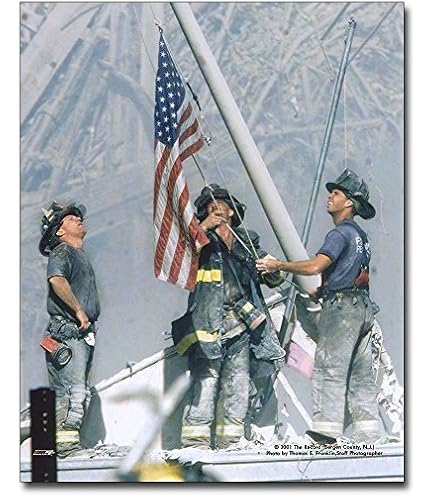
Up at 8:15a on Friday, a cloudy, 68°,, rainy morning, I made coffee, scanned the weather and news sites, and tuned into the "CP Show", from 9-12. It's a 9-11 day, 25 years after that awful day in 2001. I didn't shed a tear, but my anger, hate and rage made me furious. I called all the Ol' GC&N Staff and Landscape Crew in at 12noon, told them they'd get paid for the full day, and sent themk home to be with their families. I kept my composure during that meeting, but I was BEYOND FURIOUS.
I called Sis and Sherry to see how they were doing. Sis had been watchinga lots of 9-11 shows live on FNC, and Sherry was doing housework, and both were OK. I did some condo chores, took a short 1hr nap on the LR couch, watched some of the 9-11 documentaries on TV and went over to the CHCA community mailbox to get my week's mail.
After dinner and the 6p evening news, I watched more 9-11 shows with unseen footage of that day, TWC's "Weather Gone Viral" and the 11p news, and unplugged for the night at 11:30p.
Tomorrow starts a new week, here in the "Journal", and with a late week Dr's app't and last week's missed Labs (bloodwork), I have a clear week. Sherry's already on the schedule.
NEVER FORGET!
Every Muslim in Congress Demanded America Pay Reparations to Muslims for 9/11
Last September 11, every Muslim in Congress and some of their radical allies teamed up on a congressional resolution demanding reparations to Muslims for their suffering after 9/11.
House Resolution 741, introduced a week after the anniversary of September 11, claimed that “in the aftermath of September 11, 2001” Muslims “experienced hate and were targeted by the government” and called for “various forms of relief to support those affected.”
The money would have potentially gone to Islamic groups listed as terror co-conspirators.
While the resolution did not specify which “community-based organizations” that “center the experiences and demands of Arab, Muslim, Middle Eastern” and others would have benefited from Congress “allocating resources”, potentially millions of dollars, the official endorsees of the resolution included the Council on American-Islamic Relations (CAIR) which was named as an unindicted co-conspirator in an Islamic terrorist funding trial raising the possibility of these 9/11 ‘reparations’ going not just to Islamic groups, but even to those linked to Islamic terrorism.
Other Islamic groups that endorsed and could have potentially benefited from the ‘9/11 Muslim reparations bill’ including Muslim Advocates, the Muslim Public Affairs Council (MPAC), Muslims for Just Futures and the Muslim Justice League had their own ties to unindicted co-conspirators in terror funding. These include CAIR and the Islamic Society of North America (ISNA) where key figures had championed violence and whose former officials included an unindicted coconspirator in the World Trade Center bombing as its former vice president raising the troubling possibility that ‘9/11 reparations’ money could have benefited advocates and organizations tied not only to Islamic terrorism but even to the original WTC attack which had been carried out by the nephew of the mastermind of the September 11 attacks.
The four Muslims in Congress at the time had joined forces to equate the Americans killed in the 9/11 attacks with the Muslims, including Al Qaeda terrorists, they claimed had suffered at the hands of the United States of America. The congressional resolution complained about “overreaching policing, surveillance, and criminalization policies”, “discriminatory searches and seizures of Arab, Muslim, Middle Eastern” and others, as well as “torture at Guantanamo Bay to extrajudicial drone strikes” against Al Qaeda members.
While the Muslim reparations resolution claimed that innocent Muslims were wrongly targeted, the text of the resolution included Al Qaeda terrorists and made no distinction between them.
Beyond “resources”, the resolution also called for dismantling counterterrorism measures, both private and public, arguing that “Joint Terrorism Task Forces Preemptive Prosecutions, Countering Violent Extremism Programs, Suspicious Activity Reporting, Watchlists” continue to “profile and unfairly target Arab, Muslim, Middle Eastern” and others, and called for an “independent commission to work with community-based organizations to review these government policies, investigate and document their impact, and provide recommendations to dismantle those policies.”
These “community-based organizations” could potentially have included unindicted terrorism co-conspirators and Islamic organizations that partnered with terror-linked groups and who would be put in charge of dismantling counterterrorism measures and asked to “create alternatives to law enforcement” which would have meant applying police defunding to national security defenses against terrorism.
Finally, much as studies were conducted on the health of police officers and firefighters who were at Ground Zero, the resolution called for the National Institutes of Health to study the ”impact of hate, government targeting, political rhetoric, and profiling” on the health of Muslims as if they had been breathing ash, instead of complaining about negative media coverage.
The insulting premise of the resolution that Muslims suffered after 9/11 and deserved reparations was based on a series of lies. The Muslim 9/11 reparations resolution claimed that “Waqar Hasan in Dallas, Texas, and Adel Karas in San Gabriel, California, were killed on September 15, 2001” as evidence of some large American campaign of hate against Muslims.
Adel Karas, a Christian, and Waqar Hasan were killed in attacks by criminals on stores.
Muslims insisted that the Karas murder was Islamophobic because his store was a block away from a mosque. In reality, Karas was a Coptic Christian who had fled Egypt because of the Muslim persecution of Christians. Homicide detectives believed that the storeowner had been targeted in an extortion attempt and identified the killers as Latino gang members who had previously threatened him. Despite that, the murdered Christian store owner’s name continues to be falsely listed as evidence of an American “climate of hate” after September 11.
Hasan was one of two store personnel, one Muslim and one Hindu, killed in a series of armed robberies in Texas. Mark Stroman, who committed his first armed robbery at only twelve years old, had an extensive criminal record and had ordered a Hindu man working the counter to “open the register or I’ll kill you”. The case became famous because Stroman, a career criminal, mistakenly thought the authorities would let him get away with it by claiming that he had done it out of “patriotism” and to avenge his imaginary sister who died in the World Trade Center.
In reality, there was never any sister and Stroman wasn’t a racist Neo-Nazi: his wife was actually Hispanic. Despite that, the media, activists, and politicians spent the next 10 years helping Stroman keep the lie alive. A documentary was filmed about Stroman getting over his racism and the media covered the campaign by one of the Muslim clerks whom he shot, but who survived, to forgive him and spare him the death penalty. Skeptics wondered whether this was because Stroman was more useful while alive. The propaganda campaign went on with Supreme Court appeals and press interviews until the serial robber was finally executed.
If there really were a campaign of violence targeting Muslims after 9/11, lies like these wouldn’t have been necessary. The victimhood narrative peddled by Islamic groups, some of whom continue to support Islamic terrorism, is out to erase the horrific crimes carried out by Muslim terrorists against Americans on September 11 by claiming that Muslims were the real victims.
Americans deserve reparations and apologies for the crimes committed against them by Islamic terrorists whose motivations were derived from the Koran and from Islamic law, and which were backed and enabled by Muslim governments including Pakistan, Afghanistan, Qatar and Iran.
Instead of offering an apology or a statement of heartfelt contrition for the 9/11 attacks, Muslim members of Congress arrogantly demanded reparations from Americans for September 11.
The congressional resolution supported last year by every Muslim in Congress spat in the faces of every American who was murdered on September 11 and did it on the anniversary of their murders while arguing that the real victims of 9/11 were the terrorists locked up in Gitmo.
What will they do this year?
© 9.06.2026 by DANIEL GREENFIELD, "Sultan Knish".
9/11 Was The Beginning Of A Religious War That We Lost.
Twenty-five years ago this week I listened to the late historian Stephen Ambrose deliver the opening remarks for a conference about World War Two at Hillsdale College. He had good news for us. The 21st century, Ambrose declared, would be an era of peace and progress. He said the major conflicts of the 20th century, the two world wars and the Cold War that followed, were fundamentally disputes within the West over competing visions for our civilization. The whole century had in a sense been a long civil war, and now the war was over. We thought religion had no real influence on peoples and cultures, so we failed to recognize the religious nature of the conflict.
Instead of blood and treasure being sunk into massive wars, the coming century would instead see our efforts spent in research and exploration of the oceans and space. The notion that the post-Cold War era would be a clash of civilizations, as the political scientist Samuel Huntington argued in his 1996 book, was totally wrong, according to Ambrose. There was no coming clash because no one could compete with the West, and the West was now at peace with itself. We could rest easy, our future was bright.
Two days later the planes hit the towers.
Today, it’s easy to see just how naive and shallow Ambrose’s analysis was. The idea that there would be no more major ideological conflicts, or that Western civilization had nothing to fear from competing cultures and peoples, was positively delusional.
But it was a delusion enabled and strengthened by a fundamentally secular worldview that refused to take the claims of religion seriously — claims that precede and give coherence to political claims and ideologies. It was a delusion, in other words, enabled by an Enlightenment philosophy that looked on religion as a quaint relic of a bygone era. The religious conflicts of earlier epochs had naturally given way to the ideological contests of the 20th century, and now those contests were settled. At the dawn of the 21st century, no one could possibly take religion seriously, or think that medieval religious disputes had any relevance in the post-Cold War world that was taking shape.
Then 9/11 happened. But instead of shattering this delusion, great efforts were made to shore it up. This proved difficult (but not impossible) because the leaders of al-Qaida were obviously motivated by religious beliefs, and said so repeatedly. In his November 2002 Letter to America, Osama bin Laden explained his motivations and aims in great detail. Organized as a series of questions and answers, the letter laid out al-Qaida’s reasons for attacking on 9/11 and also stated what al-Qaida wanted from us.
“The first thing that we are calling you to is Islam,” bin Laden wrote. It’s a striking admission. The terrorists’ first priority was not for the U.S. to leave Muslim lands, or halt support for Israel, or stop propping up authoritarian regimes in the Middle East. All of those demands come after what bin Laden says is the first thing he wants for America, which is conversion to Islam: “The religion of the Unification of God … of complete submission to His Laws; and of the discarding of all the opinions, orders, theories and religions which contradict with the religion He sent down to His Prophet Muhammad (peace be upon him).”
Despite such an explicit statement from bin Laden, and others like it from jihadist Muslims around the world, almost no one in the West wanted to acknowledge this reality and its implications, because doing so would undermine the animating idea of the post-Cold War project. If sincere religious convictions could inspire Muslims in the 21st century to carry out attacks like 9/11, then it wasn’t really true that all religions are the same. And if that’s the case, then all peoples and cultures are also not the same, and neither is all labor, and suddenly the entire agenda of creating a borderless world of global free markets is called into question.
So almost immediately after 9/11 our political leaders and most major media outlets scrambled to declare that Islam had nothing to do with the attacks, that there was nothing to fear from Muslims, and that anyone who suggested otherwise was a bad American.
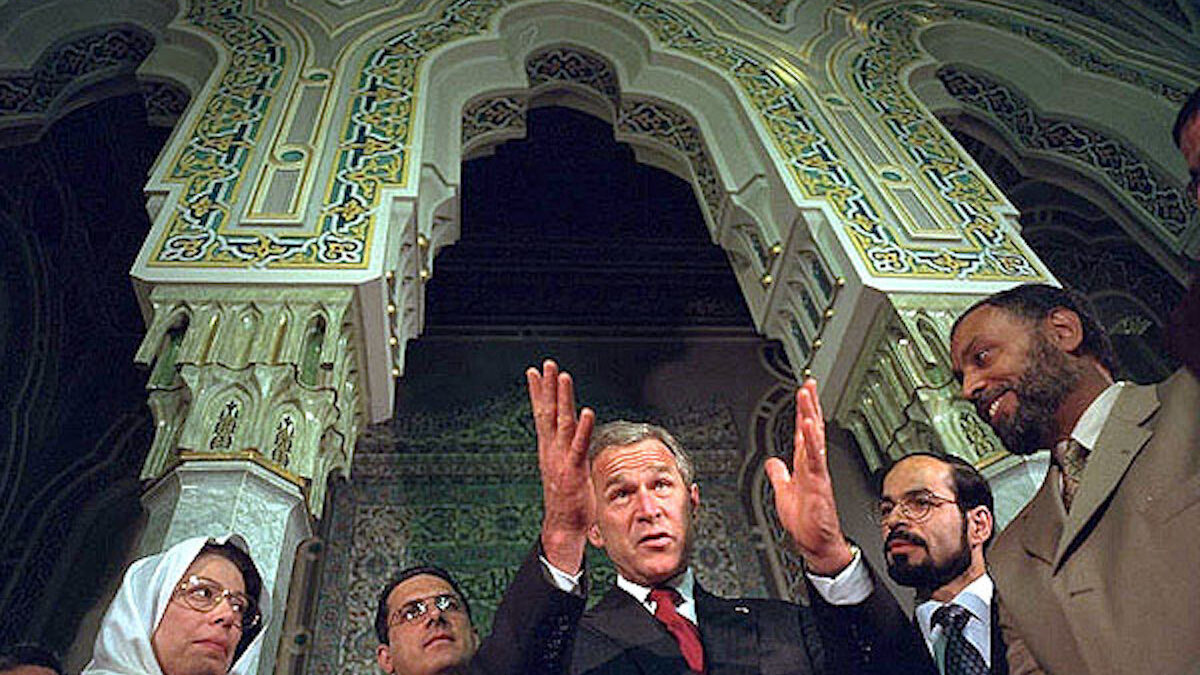
Less than a week after 9/11, as the rubble of the Twin Towers was still smoldering, President George W. Bush gave his now infamous “Islam is peace” speech after meeting with Muslim leaders at the Islamic Center of Washington. “The face of terror is not the true faith of Islam,” he said. “That’s not what Islam is all about. Islam is peace. These terrorists don’t represent peace. They represent evil and war.” The terrorist attacks, he said, “violate the fundamental tenets of the Islamic faith. And it’s important for my fellow Americans to understand that.”
It was an absurd thing for an American president to say (as if Bush knew the first thing about the fundamental tenets of Islam), but it was especially absurd, and indeed offensive, as a response to terrorist attacks that had just killed thousands of Americans. Adding to the insult and absurdity was the fact that Bush was surrounded by Muslim leaders who condemned the attacks on narrow grounds but shared the overall religious worldview of the hijackers and their al-Qaida handlers. But in Bush’s version of the world, those people were no different than any other Americans, and in fact “love America just as much as I do.”
In saying these things, the president was simply expressing the mainstream liberal view, shared by almost all our political and media elite, who were unable to recognize the religious and civilizational nature of the conflict that had erupted. It was inconceivable to them that authentic religious beliefs could ever motivate anyone to commit an act of mass violence like 9/11. After all, religions were all supposed to be fundamentally the same. They all teach the same things, more or less, and they all lead to peace. Evil and cynical people might try to twist religion and use it to justify their crimes or a political agenda, but such people are not — and cannot be — true representatives of religion.
We heard versions of this over and over again in the years after 9/11 — and especially in the lead-up to the Iraq War. All people, we were told, yearn for liberty, hence we would be greeted as liberators in Iraq. All nations should be organized along the lines of liberal democracy, hence we should ensure that Afghan women are able to get degrees in women’s studies and Afghan girls are able to attend school. What’s more, we could import democracy to these places, and it would work because freedom and democracy are what everyone, everywhere, really wants. In his second inaugural address, President Bush stated explicitly that “it is the policy of the United States to seek and support the growth of democratic movements and institutions in every nation and culture, with the ultimate goal of ending tyranny in our world.”
Ending tyranny in the world might sound like a ridiculous thing for a White House administration to tackle, but they were serious about it. I remember a political science professor of mine from Hillsdale being dispatched to Iraq by the State Department in 2004, after we had toppled Saddam Hussein. He was part of a group of scholars the government had tasked with establishing a basis for Western-style rule of law and constitutionalism in the Koran and in Islamic tradition. That such a basis had not yet been established or discovered in the previous 1,400 years of Islam did not dissuade them. They really thought it was possible, and went to great lengths in the attempt, which of course failed.
It never occurred to them that not all religions and cultures are actually the same, and do not produce the same things. It never occurred to them that Christianity, not the act of voting, is why representative democracy created peace and stability in the West. Or that it might not be possible to establish a basis for constitutional democracy in a Muslim nation because of the nature of Islam. Or that not everyone, in fact, yearns for liberty. Some people yearn instead for justice. Some people would rather have vengeance than freedom and prosperity. If you introduce democracy to a place like Iraq, or Syria, or Gaza, the people might not vote for Western liberalism. They might vote for Hamas.
Even if these things did occur to our leadership class, as they might well have, it would have been unwelcome to bring them up at the time. And in fact almost no one said anything along these lines.
Instead, our leaders doubled down on Stephen Ambrose’s version of the world. The cultural mood of the West in the decade before 9/11 was one of breezy optimism and post-Cold War insouciance. After 9/11 this mood transformed into official policy. Not only did we think we could bring Western-style democracy to tribal Muslim peoples, we thought we could bring those peoples here and integrate them into American life.
The multicultural propaganda that had been fed to us in school throughout the 1990s took shape after 9/11, and we began importing Muslims from far-flung countries in record numbers — people from the same countries that had celebrated and danced in the streets when the towers fell. Pew Research estimates the number of Muslims in the U.S. grew from 2.4 million in 2007, the first time it performed such a tabulation, to 5.5 million today (likely a low estimate). The number of mosques has likewise increased during those years, from an estimated 1,200 to 2,800.
For the left, this was only fair. A legacy of colonialism and American meddling in the Middle East was after all to blame for the backwardness and economic depression of the Muslim world, they argued. We owed it to those countries to allow mass immigration to the West, and if Muslims in the Third World harbored resentment against America, they had good reason for it. This is now mainstream thinking among Democrats. New York City Mayor Zohran Mamdani has repeatedly defended calls to “globalize the intifada,” for example, and has campaigned with the likes of Hasan Piker, who said that the United States “deserved 9/11.”
For the right, it took the arrival of Donald Trump even to be able to talk about these things. And even now, if you have the temerity to notice that Muslims in America fail to assimilate because they have no interest in assimilating, or that they recreate versions of their home countries and cultures here in America, or that Islam is clearly incompatible with American society, half the country will call you a racist.
That is the real legacy of 9/11. It was the beginning of a religious war that we lost because we refused to recognize the religious nature of it. We were committed instead to a secular account of the world in which religion makes no real claims on its adherents and imposes no real costs on unbelievers.
What we owe the victims of 9/11, all these years later, is to be done with all that nonsense, and to see the world, finally, as it really is.
© 9.10.2026 by JOHN DANIEL DAVIDSON, "The Federalist".

